
Thursday, July 7, 2011
How I feel about Global Warming
There's no doubt global warming presents a serious scare to those who feel it's true. The idea is that coal-powered & sulphur emitting power plants are blocking the sun's heat. In turn the drastic climate change is increasing the volume of water worldwide. Just recently the blame was shifted to China's industrial bubble, but I have my own cynicism on the matter. It's clear we have been beyond reckless with the O-Zone layer and our natural environment. But after doing research it's become clear to me that we've blamed the entire thing on CO-2 emissions. And around the year 2000 the temperatures stopped rising with the CO-2 levels. This proved that we really had no idea what was causing Global Warming or if it even existed. I believe the theory is nothing more then a gambling chip for politicians, after all billions of dollars pour into "global warming prevention".

My View on Recycling
I believe we are reaching a peak of our wastefulness, if we continue to waste on this level we could reach a point of no return. All of our waste is dumped into monstrous landfills where it accumulates much more volume than can be held. One of the unfortunate solutions is incineration which unfortunately vaporizes the debris into dangerous toxins. Recycling is a loop hole to this entire process, your output has no need to be transformed into toxins when in can be transformed into new product. Not only does it directly help by reusing, but it slows down the creation of new mass for new products. All in all I think Recycling has increased significantly over the pass decade or so. Nearly every home has a recycling bin, and a recycled goods pick up day. Places like the FGCU dorms have not implemented a recycling program yet, but I feel eventually this will have to take place on such a green campus.
Wednesday, July 6, 2011
Koreshan State Park
After only completing five hours at Calusa Nature Center, I needed one more service learning day of 5hrs to reach the 10 hour limit for Colloquium. Me and Sara Rieverley traveled to 41 and Corkscrew at 8AM with no idea what would be at hand. A park ranger had us fill out a few papers and then gave us a guide to the facility. He gave us a quick education that the Koreshan Settlers brought in many exotic plants that were endangering native plants and wildlife. The only way to control these devastating native plants was by routine controlled burnings. Unfortunately the Summer in FL is too humid and controlled burns present a potential threat of forest fires.
Me and Sarah entered the settlement with no idea what would be in store for us. I was expecting another nature preserve like the previous field trips, but Koreshan Park was nothing like this. An abandoned city holding no more then 10 buildings stood with a wild assortment of plants. The small settlement bordered Estero River, and once was home to over 200 citizens. The town was founded by Cyrus Teed, an alchemist and religious pioneer. Koresh itself is hebrew for Cyrus, which was the name of the religion he created "Koreshanity". He believed the town would be a "New Jerusalem" and ultimately he'd become the "New Messiah". Teed had many crazy theories including the hollow earth theory, which is absurd with the knowledge we've attained today.
 Sara with Teed's actual Hollow Earth model
Teed was severely injured in a scuffle with a Fort Myer's Marshall, and these injuries would eventually lead to his death. The Koreshan people left his body in a tub, awaiting his resurrection to no avail. His body would then be buried on Fort Myers Beach under 24hr guard until he was finally washed away. This would be the beginning of the end. By 1983 the last Koreshan would die on the grounds of the State Park. The Koreshans had great intent at building a city that would house a population of 10 million. Unfortunately for us the plants they brought with them would outlive that dream, and to this day we are battling these exotic plants.
 Cyrus Teed's New Jerusalem
Clair, a park ranger at the grounds had us help remove some of these dangerous plants by hand. She explained that plants like the Bamboo, and Monkey Puzzle Trees were traded between the Koreshan's and Edison. The Bamboo in particular has been one of the most rampant spreaders, it can be found far outside the grounds of the state park. We were told to remove two plants in particular Cesar Weed (an invasive weed that grows sharp thorns), and Rosary Weed which is infamous for climbing and destroying other plants.
 Bamboo spreading rapidly on the Koreshan Nature Walk
Me and Sarah entered the settlement with no idea what would be in store for us. I was expecting another nature preserve like the previous field trips, but Koreshan Park was nothing like this. An abandoned city holding no more then 10 buildings stood with a wild assortment of plants. The small settlement bordered Estero River, and once was home to over 200 citizens. The town was founded by Cyrus Teed, an alchemist and religious pioneer. Koresh itself is hebrew for Cyrus, which was the name of the religion he created "Koreshanity". He believed the town would be a "New Jerusalem" and ultimately he'd become the "New Messiah". Teed had many crazy theories including the hollow earth theory, which is absurd with the knowledge we've attained today.

Teed was severely injured in a scuffle with a Fort Myer's Marshall, and these injuries would eventually lead to his death. The Koreshan people left his body in a tub, awaiting his resurrection to no avail. His body would then be buried on Fort Myers Beach under 24hr guard until he was finally washed away. This would be the beginning of the end. By 1983 the last Koreshan would die on the grounds of the State Park. The Koreshans had great intent at building a city that would house a population of 10 million. Unfortunately for us the plants they brought with them would outlive that dream, and to this day we are battling these exotic plants.

Clair, a park ranger at the grounds had us help remove some of these dangerous plants by hand. She explained that plants like the Bamboo, and Monkey Puzzle Trees were traded between the Koreshan's and Edison. The Bamboo in particular has been one of the most rampant spreaders, it can be found far outside the grounds of the state park. We were told to remove two plants in particular Cesar Weed (an invasive weed that grows sharp thorns), and Rosary Weed which is infamous for climbing and destroying other plants.

Calusa Nature Center & Planetarium
After receiving an email from all the Colloquium teachers I went to an event off a Colonial at the Calusa nature center. The event was aimed mainly at children with arts and crafts, water balloon fights, face painting, and youth raffles. When me and my buddy Corey first got there we had no idea how much wildlife the center contained. After walking for less then a minute we saw Eagles, Hawks, an Albino Raccoon, and a Gator pit.
We volunteered with the kids for about an hour, and set up some of the heavier tables. The head of the department Melinda found us and told us she could use some volunteers in the Planetarium. I hadn't been to a planetarium in years but I thoroughly enjoyed running it.

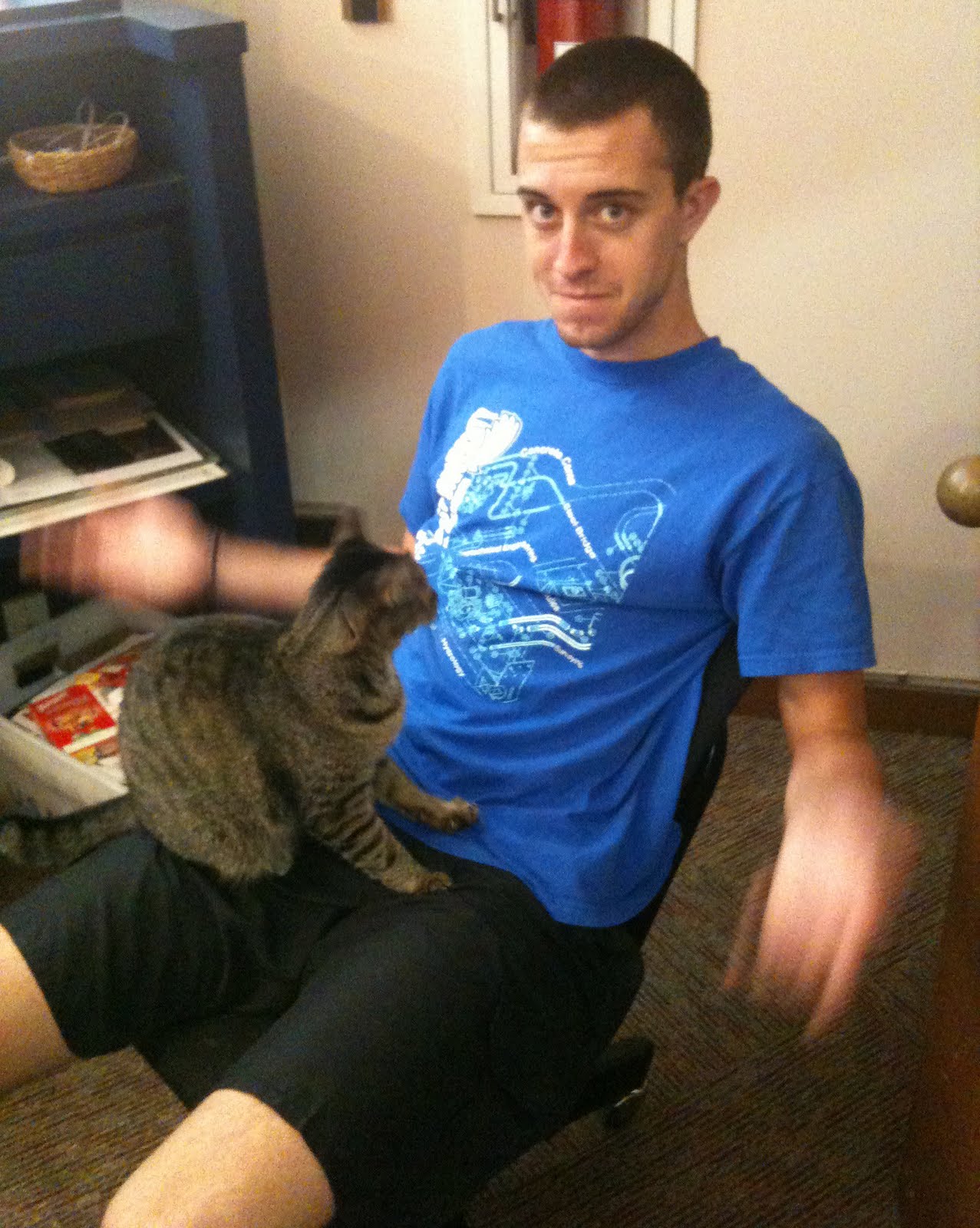
The Planetarium Cat and my buddy Corey
Sunday, July 3, 2011
Feildtrip 4 - Downtown Fort Myers
Search the internet for New Urbanism, what is it? Does your place fit this description or not? Why?
New Urbanism is defined by Wikipedia as "an urban design movement, which promotes walkable neighborhoods that contain a range of housing and job types." I felt Downtown Fort Myers definitely had a feeling of walkability. There range of housing varied significantly, I feel any social class would be able to fit it their. While they had basic Pizzerias there was also dockside dining. The jobs varied significantly from city workers, to artist, to realtor agencies.
Where in the city or urban space makes you feel most comfortable and energized?
I feel most comfortable sitting on a bench with a friend. Metaphysically everyone wishes they could pause time but thats impossible (for now). Sitting down on a bench or even the curb for at least five minutes can sometimes be the best way to understand ways of the human race. Take in your surroundings and "People Watch" those unsuspecting bystanders.
How does the urban landscape make you feel?
I'm a city kid so I always feel more at home in a modern landscape setting. I was brought up in a highly populated area, and I go to NYC at any chance I get. To me there's a feeling a of completion, and that everything I need is within a few blocks of me. When I'm out of the country I don't have this calmness, I suppose this is part of the modern weakness. This is where my strongest feeling of sense of place exist.
How much does parking cost? Where is it most expensive?How much of the city space is devoted to vehicles….traffic, parking, service of vehicles compared to space for people to enjoy the city?
Parking cost me $4 dollars in the Fort Myers city parking garage, only because I'm awful at parallel parking. A dollar fifty gets you about an hr on the meters near where I was parked. Before reading this question I never thought about it, but I'd say 50% of the landscape is devoted to traffic, and parking. This number should not be so high. Fort Myers is not that crowded that parking garages should exist on every block.
What is the biggest generator of parking need e.g. retailing businesses, service business, or government centers?
I'd say majority of the parking is for visiting traffic, or tourist. The next largest would have to be city workers involved with the courthouse and city maintenance.
Is there evidence of shared or cooperative parking arrangements between churches and businesses or government entities that use parking at different times?
Much of the parking is recycled for event parking or use between city workers and visitors. The church parking lots appear to be shared during non-church hours.
What is the current economic lifeblood of the city?
I'd say the aim is middle class in downtown fort myers. Some of the galleries can be extremely pricey, but the city itself is very old. With only a small portion of the city being renovated the price increase has not changed much since I moved here four years ago. I feel after the city sees a larger renovation we could see a huge spike in prices.
Where do people who live in the inner city shop for groceries?
Honestly I personally never saw anywhere within the city that sold groceries.
Are there signs of homelessness, graffiti, and crime in the urban spaces? If so, what indicators provide your evidence? Do you feel comfortable traveling in all parts of the city day or night? Are tourists safe in this urban area? Would you consider living here?
Honestly I did not see any homelessness, graffiti or crime. This is one of the cleanest cities I've ever been to. I feel perfectly safe traveling there anytime of day because it seems fairly safe. I'd say tourist are just as safe, no crime. The city was to small for my liking,I could live there but it wouldn't be my first choice.
Sunday, June 19, 2011
ECHO

- Explain the relationship and the complexity of production, marketing, distribution and consumption of the product (s).
The ECHO or Educational Concerns for Hunger Organizations is by far one of the most innovative things I’ve ever seen. They model household products after some of our most advanced efficient agricultural tools. These models are then presented to developmental countries with fewer resources then needed to create the real thing.

- Explain the key relationships between the soil, water, and climate that influence this agribusiness.
As agribusiness is literally the business of growing and selling foods (whether crops or animals), the natural ecosystem/weather/climate can be the difference between a successful year and complete disaster. Part of ECHO’s mission is to educate on the correct conditions to prevent further losses.

- What is the economic relationship of the agribusiness on the state, nation, and world?
Agribusiness is a supportive aspect to many different groups of people. First off agribusiness is by far one of the largest imports next to oil, and consumer goods. State exports increase revenue significantly. Then on national scale they can be taxed locally to create monetary benefits for the federal government. Now the largest scale, the world in tern is able enjoy the contents of another nation. This is especially invaluable in areas of droughts or malnutrition. Agribusiness keeps the world spinning.

- What are the economic and environmental issues concerning this business in this area?
Reed Scott answers this question best, “You must give to get, and you must sow the seed, before you can reap the harvest.” This could not me true when it comes to creating a successful agricultural project. The largest economic system is funding the initial project. In the U.S. were corporations control our agriculture market money is not a problem, but in a third world country where crops are grown for survival money is lacked. These methods ECHO creates are economically feasible because it can be made from scraps, or left over composite that no one wants.
Environmentally speaking if these methods spread on a mass scale a large chunk of waste would be removed from waste and recycled into something efficient. If there were a demand for trash it would no longer be trash-helping shrink the global waste pool.

- Identify the person(s) you interviewed in this field experience and state their perspective concerning the environment, food production and distribution.
I interviewed Bill Hooth the ambassador progam coordinator of ECHO. He explained ECHO is sparking new ideas. The limit of our potential is our own imagination. He works closely with anthropologist that travel the world to teach them simply “how to teach others”. He is a seven year ECHO veteran.

- How can you become involved in finding solutions to feed the hungry?
- In your opinion, is this activity sustainable? Explain.
The first thing that comes to mind for me is canned food drives. As cliché as they are the job gets done. Many soup kitchens run off the donations of these goods. On a larger scale something like ECHO is also an extremely great idea. Not only does it create food for those in need but also it creates a constant flow of food. This is absolutely sustainable because the product is being grown; there is no wrapper to be recycled.

- What do we have to do to feed the one billion people (one sixth of the world’s population)? Or is this the solution? If not, what is?
You can give a man a fish and he’ll eat for a meal, but give a man a fishing pole and he’ll eat for a lifetime. Self-productivity is our main solution to this hunger problem. Obviously there are more extreme conditions where nothing can be grown do to weather/soil/climate this were humanitarian aid is the only method that will make a difference. Even with a percentage of outliers, this is our most promising method to ended majority of the worlds starvation.
Friday, June 3, 2011
Field Trip Two - Matanzas Pass preserve

The Matanzas Pass Preserve one a few natural preserves still in existence was a sample of what Florida used to be. Pass the populated over developed stretch of Fort Myers Beach lies a haven for the mangroves that once bordered the entirety of Estero Bay. Bordering a small elementary lies one portable, and a wooden post with "Matanzas Pass Preserve" inscribed in all bright yellow text. Upon entering you receive your first taste of this bookmark in time. A small bridge takes you over what is mainly red mangroves. In this environment I feel an calmness, or serenity. The noises I hear are rustling of leaves with small animals making their way through the daily routine.

The landscape has been shaped in many ways. The preserve has been split into three main categories Mangrove Loop, Coconut Trail, and Caloosa Loop. Each area shapes it's environment differently. The Mangroves work as a gate between land and Estero Bay. The Mangrove tree is and adaptation of a normal tree with the ability to take in ground water and saline water. A normal tree could not process saline therefore this tree could be looked at as a guardian. For the most part Matanzas Mangrove Loop looked very lively and healthy.

After I passed the Overlook I saw the livelihood of the Mangroves sharply declining. From the research I gathered this was caused by hyper salinity. Hyper salinity is an over abundance of saline water pushing freshwater back. The Mangrove relies on an balanced intake of both forms of water. Another strong factor to condition of the Mangroves was that it was filled with water, a few weeks before summer/rain season was here this area would be very dry. The typography allowed a healthy separation of woods from mangroves as the underground water filtration needs to change. Unfortunately spoil piles which were extremely elevated allowed the growth of exotic plants that effected much of the preserve's life forms. These would be removed in 1996.

The five tree species I saw were Oak Hammock, West Indian Mahogany. Australian Pine, Groundsel Tree, and Portia Tree. Five non-woody plants I saw were the mangrove spiderlily, Chandelier plants, Tree seaside oxeye, Devil's Backbone, and Sea grape. A list of five birds I saw included Great egret, Blue heren, Osprey, Mockingbird, and a White Ibis. I did not see any fish, or amphibians. I did however see many Green anoles, and Mangrove tree crabs.

A unique fact I found is that the name origin of the name Matanzas has been lost in time. The word literally translates to slaughter in spanish had I known that I might have selected a different location. As one of the guides I read explains this name could be derived from Ponce de Leon's troops battling local natives Calusas. I experienced my own personal slaughter on this site as mosquitoes, and sand flies tore me apart.

From what I have read online the Matanzas Pass was never threatened to be built upon, the only human presence was the creation of Foot trails. The preserve eventually was modified to start dealing with mosquito breeding control by draining of canals. In 1996 Lee County took control of the preserve from the Nature Conservancy group. At this time removal of exotic plants that were pushing away native lifeforms were removed.


Subscribe to:
Posts (Atom)